logo by Jacob Neumann
ASSUME is an informal research level seminar and network
on univalent mathematics and its connections with homotopy theory
between the universities
of Birmingham,
Nottingham
and Sheffield.
The seminar provides a platform for discussing recent work where we try to
make progress on open problems. It also offers opportunities for PhD
students to get acquainted with the current interests of members of the
community.
In the academic year 2026/27, ASSUME is partially funded by the London Mathematical Society. If you would like to attend and need financial support, please contact Matteo Spadetto.
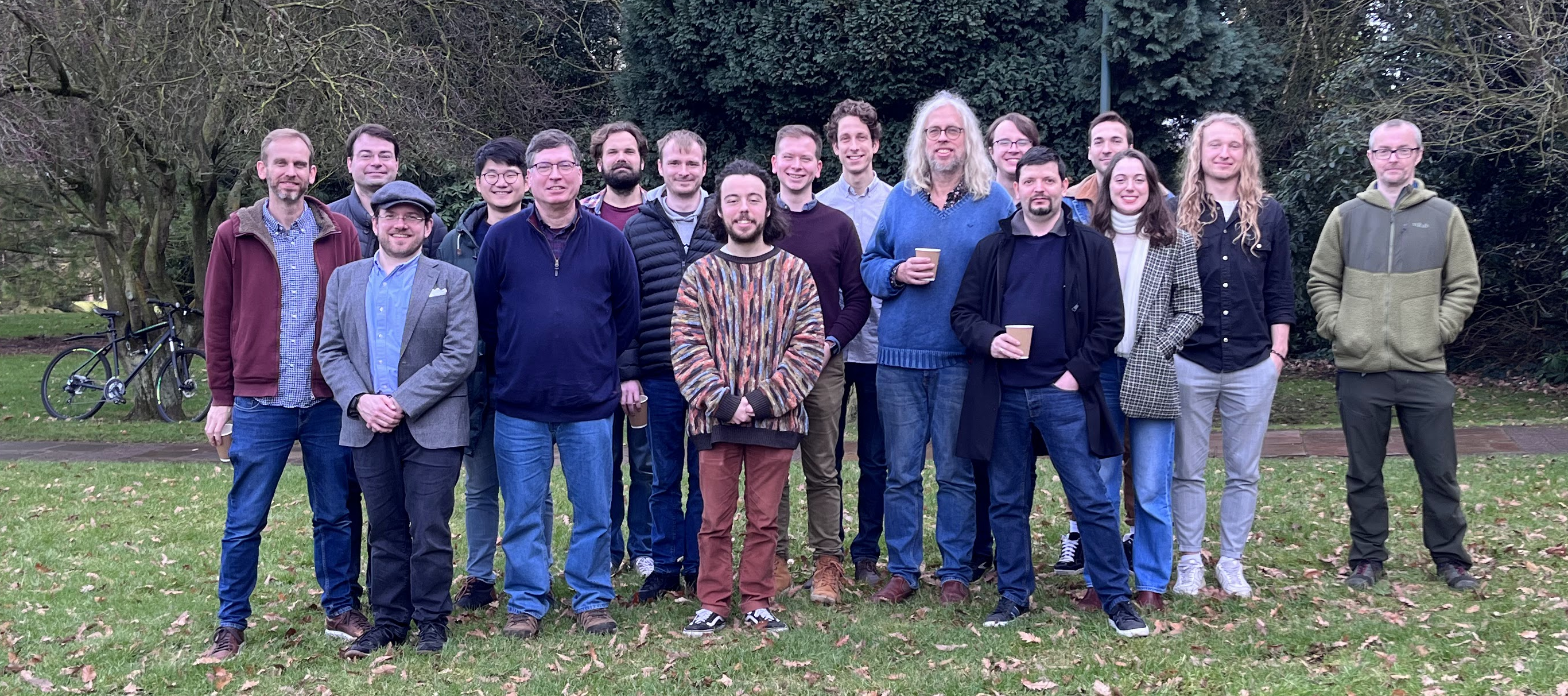
ASSUME was founded in 2022 by Eric
Finster and Tom de Jong.
Until the end of the 2025/2026 academic year, it was a joint seminar
between the universities of Birmingham and Nottingham. In 2026,
the network expanded to include the University of Sheffield.
The current organizers are
Categorical algebra is a fundamental branch of mathematics that lies at the intersection of category theory and algebra. On the one hand, it captures the fruitful properties and structures studied in algebra via category theory. On the other hand, it investigates the global categorical properties that algebraic objects enjoy when collected together. Both these endeavors are essential to extend and transport the fundamental concepts and theorems of algebra to different and broader settings. In this talk, we present an innovative theory that generalizes categorical algebra to the framework of 2-dimensional category theory. This has the notable advantage that the second dimension can be used both to weaken conditions that are too strict in nature and to refine algebraic invariants, obtaining a richer theory which encompasses a broader range of examples. Furthermore, 2-dimensional categorical algebra is essential to effectively compare different algebraic categories with each other.
After explaining how to upgrade to dimension two some fundamental notions like zero objects, kernels and exact sequences, we will present some results about exactness in dimension two. In particular, we will show how a fibrational approach led us to the notion of 2-dimensionally exact (in the sense of Grandis) 2-category. Furthermore, we will explain in which sense the 2-categories of abelian and triangulated categories are exact in dimension two.
Quotient inductive-inductive types (QIITs) provide a general framework for defining mutually dependent types with equations, but establishing the existence of infinitary QIITs constructively is difficult in general.
In this talk, I will describe a construction of infinitary QIITs in three stages. First, using the theory of signatures, the general problem of constructing infinitary QIITs is reduced to constructing a particular QIIT of signatures. Second, I reduce this QIIT to a class of essentially algebraic theories which I call conditional QW-types, extending the theory of QW-types. Finally, using inflationary iteration, I construct initial conditional QW-algebras from inductive types, quotients, and the WISC axiom.
Together, these reductions give a construction of infinitary QIITs from simpler type-forming principles and WISC.
In 2009, Awodey came up with a proposal that homotopy type theory is to (∞, 1)-toposes as extensional type theory is to ordinary toposes. More explicitly, this means that just like ordinary toposes support an internal model of set-level type theory, (∞, 1)-toposes should support an internal model of homotopy type theory.
Whilst this conjecture has been resolved for Grothendieck toposes by Shulman, the case for elementary toposes remains open— this is perhaps partially because even the definition of what higher elementary toposes is debated.
In this talk, we will discuss a truncated version of Awodey’s proposal for elementary toposes; that elementary (2, 1)-toposes should support an interpretation of groupoid-level type theory. We will investigate some problems faced by Weber’s definition of an elementary (2, 1)-topos, and show that by adding extra axioms to this definition, we can start to form an explicit model of intensional type theory. With these additional axioms, the definition begins to look like a (2,1)-dimensional version of Joyal and Moerdijk's class categories; we discuss why this might make conceptual sense.


